


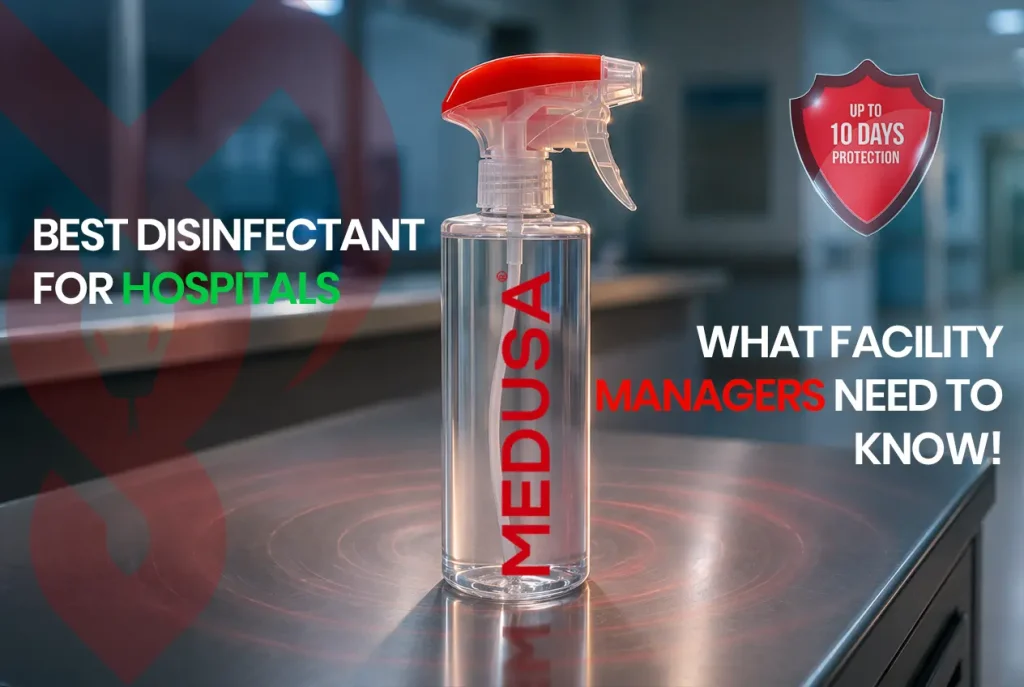
Facility managers waste thousands on disinfectants that stop working in minutes. Learn what actually matters when choosing a hospital disinfectant — and why protection duration changes everything.
Best Disinfectant for Hospitals: What Facility Managers Need to Know (But Nobody Tells Them)
Here’s a number that should keep every hospital facility manager awake at night: healthcare-associated infections affect 1 in every 31 hospital patients. That’s not a third-world statistic. That’s the CDC’s own data for modern, well-funded hospitals.
And here’s the part that stings — most of those infections are preventable.
The surfaces are being cleaned. The protocols exist. The disinfectants are being sprayed. So why are patients still getting infected?
Because there’s a gap between when a surface gets disinfected and when it gets touched again. And in that gap, traditional disinfectants have already stopped working.
The 10-Minute Problem Nobody Talks About
Walk into any hospital and you’ll see the cleaning staff doing their rounds. Spray, wipe, move on. They’re following protocol. They’re using approved products. They’re doing everything right.
Except for one thing: the product they’re using was designed to kill germs at the moment of application — and that’s all it does.
Most hospital-grade disinfectants require a contact time (also called dwell time) of between 1 and 10 minutes to be effective. The surface must stay visibly wet for the entire contact time. If it dries before that window closes — and alcohol-based products evaporate fast — disinfection hasn’t actually been achieved.
But even when the contact time is met perfectly, here’s what happens next: nothing. The product evaporates. The surface is unprotected. The very next hand that touches that bed rail, call button, or IV pole can deposit fresh bacteria.
Think about that for a second. A nurse disinfects a bed rail at 8am. A visitor touches it at 8:15am. A different nurse touches it at 8:30am. A doctor leans on it at 9am. Between 8:10am and the next cleaning cycle, that rail was a transmission risk the entire time.
This is the reality that facility managers rarely hear from their disinfectant suppliers.
What a Doctor in the UAE Taught Us About Doing the Maths
Our sales representative, Moaz, had been trying to get a meeting with a senior physician at a clinic in the UAE for weeks. The doctor was experienced, busy, and — understandably — sceptical of anyone claiming to have a better disinfectant.
When Moaz finally got his meeting, he didn’t lead with a sales pitch. He started by asking questions. How often does your staff disinfect surfaces? How much product do you go through each month? How many hours per day does your cleaning team spend on disinfection routines?
The doctor had the answers. He’d been running his clinic for years and knew exactly what he spent.
Then Moaz asked one question the doctor hadn’t considered: “How many hours per day are your surfaces actually protected?”
The doctor paused. He’d been thinking about disinfection as an event — something his staff did several times a day. He’d never calculated the total time his surfaces were actually under active antimicrobial protection versus exposed and vulnerable.
When they ran the numbers together — factoring in dwell time, evaporation rate, and the hours between cleaning cycles — the doctor realised his surfaces were unprotected for roughly 80% of the operating day.
Then they compared the annual cost of his current protocol (constant reapplication, labour hours, product consumption) against a disinfectant that works continuously for up to 10 days. The cost wasn’t just lower — the protection was dramatically higher.
He ordered the same day.
The Five Things That Actually Matter When Choosing a Hospital Disinfectant
Every disinfectant supplier will show you a data sheet proving their product kills germs. That’s table stakes. Here’s what separates a good hospital disinfectant from one that actually reduces infection risk:
1. Duration of Protection (Not Just Kill Rate)
This is the factor that changes everything. A product that kills 99.99% of pathogens but stops working in 10 minutes creates a false sense of security. A product that kills 99.99% and then continues protecting the surface for days fundamentally changes your facility’s infection risk profile.
[LINK: MEDUSA Alcohol-Based Disinfectant Spray → /en/product/alcohol-based-disinfectant-spray-500ml/] provides up to 10 days of continuous antimicrobial protection after a single application. That means bed rails, door handles, call buttons, medical carts, and waiting room chairs stay actively protected between cleaning cycles.
2. Pathogen Coverage
Your disinfectant must be effective against the specific organisms that cause hospital-acquired infections. At minimum, look for proven efficacy against Staphylococcus aureus (skin infections, MRSA concerns), E. coli (gastrointestinal infections), Pseudomonas aeruginosa (wound and respiratory infections), Candida albicans (fungal infections), and respiratory viruses including Influenza and SARS-CoV-2.
[LINK: MEDUSA’s lab testing → /en/faqs/] confirms efficacy against all of these pathogens, validated in internationally accredited laboratories under BS EN 1276:2019 standards.
3. Surface Compatibility
Hospitals contain an extraordinary range of surface materials — stainless steel surgical instruments, plastic bed controls, electronic monitoring equipment, rubber gaskets, painted walls, glass partitions, laminate counters. Your disinfectant cannot corrode, stain, or degrade any of them.
Here’s a detail that surprises people: many alcohol-based disinfectants, when used repeatedly on the same surface over months, can cause discolouration on plastics and cracking on rubber components. This isn’t visible after one application — it’s cumulative damage that becomes a replacement cost down the road.
MEDUSA’s formula is balanced to provide effective disinfection without the corrosive effects of high-concentration alcohol products, making it safe for daily use across all hospital surface types.
4. Staff Safety and Ease of Use
Your environmental services team is the front line of infection control. If the disinfectant causes skin irritation, respiratory discomfort, or requires complex dilution protocols, compliance drops. Studies consistently show that cleaning staff training effectiveness diminishes after 90 days — meaning your disinfectant protocol needs to be as simple as possible.
MEDUSA is a ready-to-use formula — no dilution required. Spray and let it air dry. That’s the entire protocol. No mixing ratios, no measuring, no PPE beyond standard gloves.
For high-traffic areas like waiting rooms and corridors, [LINK: MEDUSA Disinfectant Wipes Bucket (250 Wipes) → /en/product/wipes-bucket-250/] gives your cleaning staff a quick-grab option that’s pre-soaked and ready to go.
5. Total Cost of Ownership
This is where facility managers get tricked. They compare the price per bottle and choose the cheapest option. But the real cost isn’t the product — it’s the product multiplied by how many times you have to apply it, plus the labour hours to apply it, plus the hidden costs of surfaces that aren’t actually protected.
A disinfectant that costs twice as much per bottle but lasts 10 days instead of 10 minutes isn’t more expensive — it’s dramatically cheaper in total cost of ownership. Fewer bottles consumed. Fewer labour hours. Less operational disruption. And most importantly, fewer infection incidents.
The doctor Moaz met with understood this immediately. His annual disinfection budget didn’t go up — it went down. His protection went from hours per day to 24/7.
The Alcohol-Free Option for Sensitive Clinical Areas
Not every area of a hospital needs an alcohol-based formula. Paediatric wards, neonatal units, and rehabilitation spaces where patients have extended skin contact with surfaces benefit from [LINK: MEDUSA Alcohol-Free Disinfectant Spray (500ml) → /en/product/alcohol-free-disinfectant-spray-500ml/] — the same 10-day protection and 99.99% kill rate without alcohol, without harsh odour, and without flammability concerns.
Both formulas are available in [LINK: 5-litre bulk gallons → /en/product/alcohol-free-disinfectant-5l/] for institutional procurement, making it easy to standardise across your entire facility.
The Question Every Facility Manager Should Ask Their Supplier
Next time your disinfectant supplier visits, ask them this: “How many hours per day are our surfaces actually under active antimicrobial protection?”
If the answer is “only during and immediately after application” — you now know there’s a gap. And in a hospital, gaps cost lives.
[LINK: Contact MEDUSA for institutional pricing → /en/contact-us/] and find out what 10-day continuous protection means for your facility’s infection control and budget.
Frequently Asked Questions
What is the best disinfectant for hospital surfaces? The best hospital disinfectant combines broad-spectrum pathogen coverage (effective against bacteria, viruses, and fungi), a practical contact time, surface compatibility across all hospital materials, and — critically — extended protection duration. MEDUSA provides all of these plus up to 10 days of continuous antimicrobial protection per application, far exceeding the minutes-long protection of traditional hospital disinfectants.
How often should hospital surfaces be disinfected? With traditional disinfectants, high-touch surfaces in hospitals are typically disinfected multiple times per shift because protection ends as soon as the product dries. With a long-lasting disinfectant like MEDUSA that provides up to 10 days of continuous protection, facilities can reduce the frequency of full disinfection cycles while maintaining round-the-clock surface protection. Regular cleaning with soap and water between applications is still recommended.
Is alcohol-free disinfectant suitable for hospital use? Yes. Alcohol-free disinfectants are particularly suitable for paediatric wards, neonatal units, rehabilitation areas, and any clinical space where patients have extended or frequent contact with treated surfaces. MEDUSA’s alcohol-free formula kills 99.99% of pathogens and provides the same 10-day protection as the alcohol-based version, without flammability, strong odour, or skin irritation risks.